











Choosing a fiber laser cutter for stainless steel should start with the parts you need to make, not with the biggest wattage number on a quotation.
Your normal stainless steel grades, thicknesses, hole sizes, drawing tolerances, edge requirements and daily output all affect the final configuration. A workshop cutting thin decorative panels has a different job from a factory producing thicker parts in larger batches. Even when both buyers process stainless steel, the machine setup may be quite different.
For many sheet-metal applications, fiber laser is a practical choice because it handles stainless steel, small features and nested parts well. Finished-part quality still depends on motion control, cutting head stability, assist gas, focus, nozzle condition and machine structure.
If you are still comparing cutting processes, the Fiber Laser vs CO2 vs Plasma Cutting guide gives a useful starting point for sheet metal fabrication. Once fiber laser is the process you want, move back to your own drawings and production target.
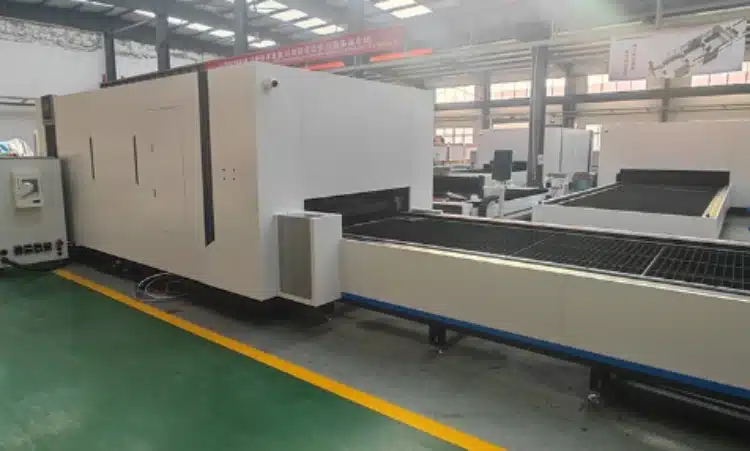
Define Your Stainless Steel Cutting Requirements
Before discussing laser power, write down what an acceptable finished part looks like.
Start with the stainless steel grades and thicknesses that make up most of your work. Then look at the part details that usually cause trouble in production. These may include small holes, narrow slots, tight corners, long straight edges, closely nested parts or dimensions that need close control.
Batch size matters too. One good prototype says little about repeat production if the result changes after several hours of running.
Also consider the next process. Parts going to bending or welding may need a different edge condition from visible panels that will be polished or assembled. Grinding, deburring and cleaning all add time.
Turn Drawings into Acceptance Items
Use your actual drawing as the basis for the machine test.
Mark the outside dimensions, critical hole diameters, hole spacing, slots, corner details and any features with specific tolerance requirements. These become the points that should be checked after cutting.
Define edge requirements too: acceptable oxidation, burr level and whether the edge must be ready for the next process without grinding.
The drawing tolerance should remain the acceptance target. Do not replace it with a general machine accuracy figure from a brochure.
Separate Machine Accuracy from Part Tolerances
Machine positioning specifications describe how the machine axes move under stated test conditions. Finished-part tolerance is a different issue.
The final part is also affected by material flatness, heat input, focus, gas delivery, nozzle condition, compensation and part geometry.
When two machines are being compared, use the same drawing and the same inspection method. Measure the same locations with the same type of tool, and inspect several repeated parts after the machine reaches normal operating condition. This gives a better picture of production performance than one positioning number.
Choose Laser Power for Your Part Mix
Laser power affects cutting capability, piercing time and cutting speed, especially as stainless steel thickness increases. More power, however, does not automatically mean better precision or better value.
Start with the thickness range that makes up most of your orders. If most work is thin or medium stainless steel, buying a much higher-power configuration may not solve a real production problem. If thicker stainless steel appears regularly and cutting time already limits output, a higher-power option may deserve testing.
The decision should come from your order mix. Short-run workshops may value flexibility, while repeat-production factories may care more about batch time and cost per acceptable part.
Compare Full Cycle Time before a Power Upgrade
Do not judge a machine only by the cutting speed shown on the controller.
Time the complete job. Include sheet loading, edge finding, piercing, cutting, exchange-table movement, unloading, part removal and any deburring or cleaning required afterward.
For parts with many holes, short line segments and sharp corners, acceleration, piercing and path strategy may limit output before laser power does.
| What You Bring | What to Record | What It Tells You |
| Main stainless steel grades and thicknesses | Share of normal orders and batch size | Which configuration should be tested first |
| Representative production drawing | Piercing, cutting and total batch time | Whether power is the actual bottleneck |
| Critical dimensions | Nominal value, measured value and deviation | Whether the sample meets the drawing |
| Edge requirements | Dross, oxidation, burrs and cleanup | Whether secondary processing is needed |
| Assist-gas setup | Gas use under the same job conditions | Effect on running cost |
| Repeated samples | Variation between several parts | Whether the result is stable |
Maximum cutting capability and normal production capability should also be kept separate. A machine may cut a certain thickness, but that does not mean the same condition gives the edge quality, speed and repeatability required for your normal orders.
For more background on matching wattage to material and production needs, see the fiber laser power guide. Use general power guidance as a first filter, then confirm the final choice with your own cutting test.
Check Machine Accuracy, Edge Quality, and Assist Gas
Once the power range has been narrowed down, the rest of the machine becomes just as important.
Servo response affects how the cutting head handles small radii, sharp corners and changes in direction. Linear guides influence movement quality. Gantry beam rigidity and machine-bed stability help control vibration when the machine runs at production speed.
The cutting head also needs stable height control. Changes in nozzle-to-sheet distance can affect gas flow and kerf shape.
Auto-focus can be useful when production switches between different thicknesses, but the presence of an auto-focus cutting head does not prove the finished parts will meet your tolerance. It is one part of the cutting system.
Keep Gas, Focus, and Nozzle Conditions Stable
Nitrogen is commonly used when stainless steel needs a bright edge with limited oxidation. This can be useful for visible parts or parts moving to bending, welding or assembly without heavy edge finishing.
Nitrogen alone does not guarantee a clean edge. Gas purity, pressure stability, nozzle condition, nozzle centering, cut height, focus position and cutting speed all affect the result.
If speed is too high, incomplete cutting or lower-edge dross may appear. Too much heat can widen the kerf and increase distortion.
A wider kerf is not automatically a defect. What matters is whether the kerf stays stable and whether the programmed compensation produces a finished part that meets the drawing.
A damaged, dirty or poorly centered nozzle changes the gas-flow pattern even when programmed parameters stay the same. Protective lenses and the optical path should also be checked during longer tests.
Validate Performance with a Sample Cutting Test
A useful sample test should look as close as possible to the work you actually plan to run.
Send the supplier the stainless steel grades and thicknesses you normally buy. Add a representative drawing and identify the dimensions or features that are most important. Victory Industry’s customized process and equipment services can be used to discuss machine configuration, sample cutting and production requirements around your material and drawing.
Avoid using only a simple square or one large outside contour for the test. Add the details that usually make production more difficult, such as small holes, narrow slots, tight corners, long straight edges and closely nested parts.
Before cutting, agree on what will be checked. Record the machine model, laser configuration, cutting head, assist gas and the conditions used for the test. For the sample itself, record nominal dimensions, measured dimensions, visible dross, oxidation, burr condition and whether secondary finishing is required.
Record piercing time, cutting time and total batch time so you can see the real bottleneck. Check gas use too if nitrogen is a major operating cost.
Repeat the test.
One clean part shows that the machine can produce that result once. Several parts cut under the same conditions give a better indication of whether the result can be repeated. If two machine configurations are being compared, keep the material, drawing, inspection method and acceptance criteria the same.
For running-cost comparisons, calculate costs around acceptable parts from the same batch. Gas, electricity, consumables, labor and post-processing can all be included, but make the calculation boundary clear. Do not use the laser source rating as a substitute for whole-machine electricity use.
Evaluate the VIP Laser Cutting Machine for Your Workshop
これ VIPレーザー切断機 is one option to evaluate for stainless steel sheet production.
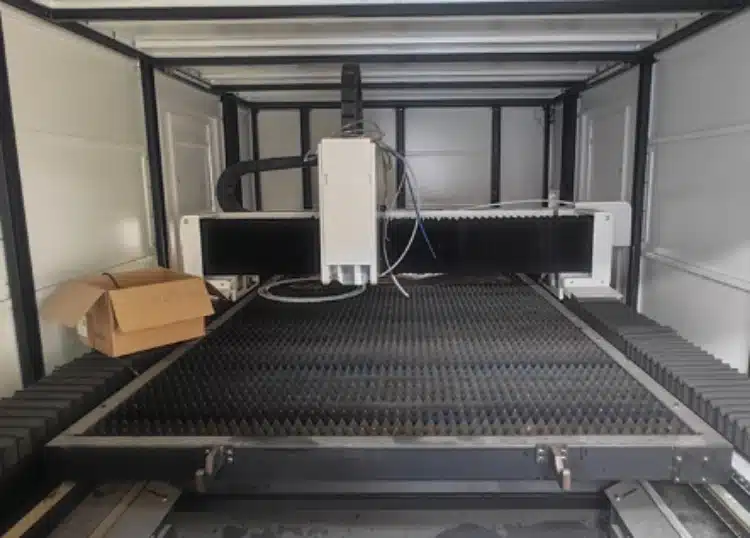
Instead of choosing it only from headline specifications, confirm the exact configuration being quoted. This should include the offered model, working area, laser source, cutting head, control system, assist-gas arrangement, cooling system and any optional equipment required for your production.
The published VIP technical parameters include positioning accuracy of 0.05 mm and repositioning accuracy of 0.03 mm. Treat these as machine motion specifications rather than a guarantee that every finished stainless steel part will hold the same tolerance.
Ask which model the figures apply to and what test conditions are behind them. Then use cut samples to check whether your critical dimensions can be produced consistently.
The same approach should be used for laser power. Available configurations can vary by model and package, so the current quotation and configuration sheet should be the basis for the purchase. If different power options are being considered, ask for a sample-cutting proposal using the same drawing.
Working area should match your sheet size and nesting plan. An exchange worktable can reduce waiting between sheets, but its value still depends on loading method, operator workflow and part removal.
A closed enclosure is a machine structure feature. It should not be treated by itself as proof of a particular safety certification. If certification or compliance matters for the installation country, confirm the exact documentation separately.
Buyers who want more background on the supplier can review ウイニングインダストリー before comparing the final configuration, service scope and commercial terms.
A useful quotation should explain why the proposed setup fits your usual thicknesses, drawing features, output level and workshop conditions.
結論
Choosing a fiber laser cutter for stainless steel comes down to the parts you actually need to ship.
Define the stainless steel grades, main thickness range, critical dimensions, edge requirements and normal batch size first. Then compare laser power, motion performance, assist-gas control, cutting quality and complete cycle time under the same job conditions.
Keep machine positioning specifications separate from finished-part tolerance. Do not assume the highest power will automatically give the best precision or the lowest cost per part.
Use your own material and a realistic drawing for the sample test. Check repeated parts, measure critical dimensions, inspect the edge and record total production time, gas use and post-processing.
For the VIP Laser Cutting Machine, confirm the current model and configuration before ordering, then evaluate it using the same acceptance items you would use for any other machine.
Planning a stainless steel cutting project? 勝利産業と結び付ける with your main material grades and thicknesses, a representative drawing, critical dimensions, typical batch size, target output, available assist gas and installation country. Request a configuration review and discuss a sample-cutting test with agreed acceptance criteria before making the final machine decision.
FAQs
Q1: Does Positioning Accuracy Equal Finished-Part Tolerance?
No. Positioning accuracy describes machine-axis performance under specified test conditions. Finished-part tolerance is affected by the complete cutting process, including material condition, heat input, focus, gas flow, nozzle condition, compensation and part geometry. Check actual cut samples against your drawing instead of using the machine accuracy number as the part tolerance.
Q2: How Should I Compare Power Options for My Usual Stainless Steel Thickness?
Use the same material, drawing and acceptance criteria on each candidate configuration. Compare piercing time, total cycle time, dimensional results, edge quality, gas use and any post-processing required. Higher power is useful when it solves a real cutting or throughput bottleneck.
Q3: What Information Should I Send for a Sample-Cutting Test?
Send the stainless steel grade, thickness, a representative drawing, critical dimensions, edge requirements, typical batch size, target output and available assist gas. If the cut part moves directly to bending, welding, polishing or assembly, include that information as well.
Q4: How Do I Compare Two Fiber Laser Cutters with the Same Drawing?
Keep the test conditions as close as possible. Use the same stainless steel, drawing, gas requirement, acceptance criteria and inspection method. Compare several repeated parts rather than one sample. Record dimensional deviation, hole quality, kerf consistency, edge condition, total cycle time, gas consumption and secondary finishing.