











When a sheet metal shop compares fiber laser vs CNC punch press, the first question is usually simple. Which one cuts faster? A fair question is what is cheaper, and what is better for our parts. However, cost is not the only factor. The true nature of sheet metal fabrication is bringing a flat piece of metal to a point where it can be bent to meet specifications. In many cases, the bending process can make or break a part whether it meets specifications or not.
So this article looks at the choice in a more practical way. First, we compare fiber laser cutting and CNC punching. Then we look at what happens after blanking, especially where a Hybrid Servo CNC Press Brake fits into the line.
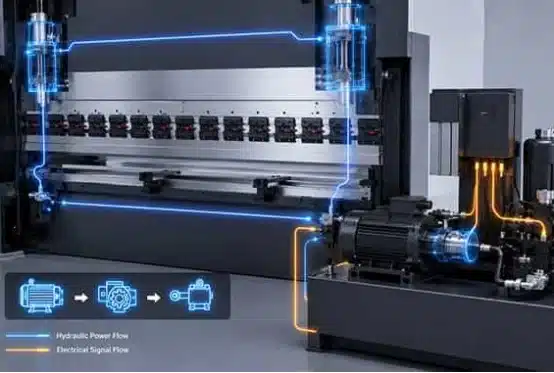
Quick Answer: Fiber Laser vs CNC Punch Press
Fiber laser cutting generally best for cutting flexible shapes, short production runs, complex cut parts and fluctuating orders. No special punch tool required for changing shape, so great for mixed production.
CNC punching is best suited for parts that have lots of repeat holes, louvers, embossing, etc. Stable high volume sheet metal parts are ideal candidates for CNC punching. Since designs rarely change over long periods of time, the tooling cost for punching can be spread over many parts.
But neither process completes the final component alone. In most workshops the accuracy of bending, the time for setting up a press brake and the consistency of the forming process are critical for turning a blank into a good part.
The Main Difference in One Sentence
Fiber laser cutting gives more shape freedom. CNC punch press gives strong efficiency when holes and patterns repeat.
Why the Final Choice Depends on the Whole Line
If cutting becomes fast but bending stays slow, parts pile up beside the press brake. If punching is efficient but bend angles are not stable, welding and assembly still take extra time. So the better choice depends on the full sheet metal fabrication line, not only the blanking machine.
When Fiber Laser Cutting Is the Better Choice
Fiber laser cutting is usually the safer choice when your parts change often. Many job shops work this way. One day they cut stainless steel covers. The next day they cut carbon steel brackets. After that, aluminum panels or decorative parts come in.
With a fiber laser cutting machine, you change the program, adjust parameters, and move on. There is no need to wait for a new punch tool. That saves time when the order is small or the drawing keeps changing.
Complex Profiles and Mixed Orders
The use of laser cutting is ideal for precise outer profiles, curved cutting, thin slots, small to medium batches and any random or unusual shape. Laser cutting is also highly suitable for prototype work, as simple alteration to a file can allow for rapid production of new prototype parts.
For machine enclosures, metal furniture parts, elevator panels, and custom covers, this flexibility matters. The part may look simple on paper, but when each customer changes hole position, size, or outer shape, tooling becomes a problem.
Multi-Material Sheet Metal Cutting
Fiber laser cutting is the typical process for stainless steel, carbon steel, aluminum, brass and copper and of course other materials. As mentioned before each material needs a certain power, gas, focus and cutting speed but the process itself is flexible.
For buyers who handle many material types, this is a real advantage. It reduces the need to build a large punch tooling library for every product change.
When CNC Punch Press Is the Better Choice
CNC punch press still has a clear place in sheet metal fabrication. It is not a machine that disappeared because of laser cutting. It is just better for a different kind of work.
If your parts have many repeated holes, standard vents, louvers, embossing, or formed features, punching can be very practical. Once the tooling is ready, the machine can process stable parts at good speed.
Repeated Holes and Standard Patterns
Electrical cabinets are a good example. Many panels need regular holes, vents, slots, and standard patterns. For this kind of part, a CNC punch press machine can still be faster and cheaper per piece when the batch is large enough.
The same logic works for some HVAC panels, appliance parts, and simple enclosure parts. If the same pattern repeats month after month, punch tooling becomes easier to justify.
Tooling Cost and Batch Stability
The weak point appears when the drawing changes often. New tools cost money. Tool setup also takes time. If a buyer keeps changing hole size or pattern, punching loses part of its advantage.
So you should not ask only whether CNC punching is cheaper. Ask whether your product design is stable enough to use the tooling for a long time.
Why Cutting or Punching Is Only the First Step
Blanking is only the start. After sheet metal cutting or punching, the shop still needs forming. For many products, that means press brake bending.
A flat sheet may be cut perfectly, but if the bending angle is wrong, the part still fails. It may not fit the cabinet frame. It may leave gaps during welding. It may cause problems during powder coating or final assembly.
Blanking Makes the Shape, Bending Makes the Part
Laser cutting and punching prepare the blank. The CNC press brake turns that blank into a cabinet, bracket, cover, door, frame, duct, or machine panel.
This is why the bending process should be part of the same equipment decision. A workshop may buy a fast cutting machine, then find that delivery is still delayed because bending setup takes too long.
Typical Bottlenecks After Cutting
The common problems are not hard to find. Wrong angle. Long setup. Slow tool change. Backgauge adjustment. Trial bends. Scrap parts. Rework before welding.
These problems are small one by one, but they eat time every day. For high-mix sheet metal work, the bending station often becomes the place where production rhythm breaks.
Where Hybrid Servo CNC Press Brake Fits in the Line
This is where Victory Industry can be introduced more naturally. The company works with laser systems, CNC forming equipment, and automation solutions for metal fabrication buyers. Its Hybrid Servo CNC Press Brake fits the step after fiber laser cutting or CNC punching, because it handles the part that blanking cannot finish.
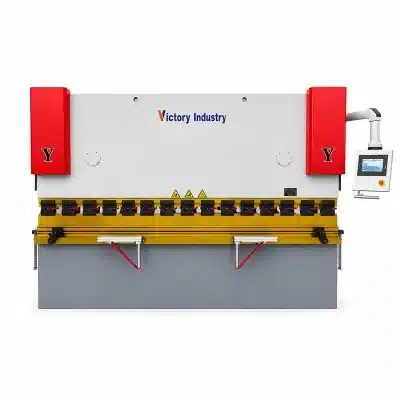
The machine uses hybrid servo hydraulic drive, CNC control, a rigid frame, servo CNC backgauge, and options such as quick clamping and CNC crowning. In plain words, it is made for bending accuracy, setup efficiency, and stable forming during daily production.
After Fiber Laser Cutting
Laser-cut parts often change shape and size. That means the press brake also has to handle frequent program changes. A Hybrid Servo CNC Press Brake is useful here because CNC programming and repeatable backgauge positioning can reduce manual checking.
For machine enclosures, elevator panels, metal furniture, and custom covers, this helps the workshop move from cutting to bending without losing too much time in setup.
After CNC Punching
Punched parts are often more repetitive, but bending still needs to match the speed of punching. Electrical cabinets, vent panels, and enclosure parts may have many holes, but the final body still depends on accurate bends.
If the press brake cannot keep up, the punching advantage is partly wasted. Stable bending helps the shop keep a cleaner flow from blanking to assembly.
How Hybrid Servo Press Brake Improves Fabrication Efficiency
When purchasing a press brake it is not just a case of looking at the tonnage, in reality the buyer wants to know will the machine repeat the performance, will the operator be able to change from job to job quickly enough, and will long parts hold the required angle from end to end.
Servo Hydraulic Drive for Daily Production
A hybrid servo press brake keeps hydraulic forming power, but the servo system helps control movement and energy use. This is useful for workshops bending stainless steel, carbon steel, aluminum, galvanized steel, and medium-thickness parts.
Older hydraulic systems may keep running hard even when the machine is not bending. A servo hydraulic press brake can reduce wasted energy and heat during long shifts. That also helps the workshop run quieter and cleaner.
CNC Backgauge and Quick Setup
Backgauge accuracy has a direct effect on bend position. If the bend line moves, the final part may not fit. A servo CNC backgauge helps keep positioning repeatable across a batch.
For high-mix production, quick clamping also matters. Operators may change tools several times in one shift. Saving a few minutes each time becomes real production time by the end of the week.
CNC Crowning for Long Parts
Long parts often have angle differences between the center and the two ends because of machine deflection. CNC crowning helps compensate for that.
This is important for cabinet doors, long covers, frames, elevator panels, and other parts where one small angle difference can affect assembly.
How to Choose the Right Press Brake After Laser or Punching
A bigger press brake is not always the better choice. The right machine should match your material, thickness, bend length, part depth, tooling, and production volume.
Match Tonnage to Material and Thickness
Tonnage depends on sheet thickness, material strength, V-opening, and bend length. Stainless steel usually needs more force than mild steel under the same bending condition. Aluminum may be easier to form, but it still needs the right radius and tooling.
For small boxes, brackets, and thin sheet parts, lower tonnage may be enough. For common cabinets, doors, and industrial enclosures, medium tonnage is often more practical. For thick plates, long plates, and heavy structural parts, higher tonnage becomes necessary.
Do not choose only by the thickest part you might make once a year. Start from your common parts.
Match Bending Length to Real Part Size
Working length should match your actual parts. If most work is small brackets, a very long machine wastes space and slows handling. If you bend long panels, frames, doors, or covers, enough bending length is important.
A good supplier should ask for drawings, material type, sheet thickness, bend length, and daily output before recommending the model.
Match Axis Configuration to Part Complexity
Simple bends may not need many axes. Complex parts need more backgauge movement, better positioning, and sometimes crowning control.
For deep parts, offset bends, multi-flange parts, and high-mix orders, 6+1-axis or 8+1-axis configurations can reduce manual adjustment. For basic work, a simpler setup may be more cost-friendly.
Practical Selection Logic for Buyers
If your parts change often, choose fiber laser cutting and match it with a flexible CNC press brake.
If your parts have repeated holes, louvers, and stable patterns, CNC punch press can still make sense. But you still need a press brake that keeps pace with the punching machine.
If your workshop handles many different sheet metal parts, laser cutting plus Hybrid Servo CNC Press Brake is usually easier to manage.
If your workshop makes electrical cabinets or panels with repeated structures, punch press plus CNC press brake can be a very practical combination.
The point is simple. Do not choose machines one by one without looking at the line. Cutting speed, punching cost, bending setup, and assembly fit all belong to the same production result.
Conclusion
Fiber laser vs CNC punch press is a useful comparison, but it should not stop at the blanking stage. Fiber laser cutting is better for flexible shapes and changing orders. CNC punching is better for repeated holes, louvers, and stable batches.
Still, both processes only prepare the flat blank. The final sheet metal part depends on bending.
That is why Hybrid Servo CNC Press Brake belongs in this discussion. It helps connect cutting, punching, bending, welding, and assembly in a more stable way. With servo hydraulic drive, CNC control, servo CNC backgauge, quick clamping, CNC crowning, and a rigid frame, it solves many daily problems that do not show up clearly on a cutting machine quotation.
Before buying, check your part drawings, material list, thickness range, bend length, batch size, and operator workflow. For model selection, installation, training, service support, or contact details, it is better to confirm the full blanking and bending setup together instead of choosing the fastest machine in only one process.
FAQ
Q1: Is fiber laser cutting better than CNC punching for sheet metal fabrication?
A1: Fiber laser cutting is better for flexible profiles, mixed orders, complex contours, and frequent design changes. CNC punching is still useful for repeated holes, vents, louvers, embossing, and stable high-volume patterns.
Q2: Can fiber laser cutting replace CNC punching completely?
A2: Not always. Fiber laser cutting can replace punching in many flexible jobs, but CNC punch press still has value when parts have repeated holes or formed features and the batch size is large enough.
Q3: Is CNC punching cheaper than fiber laser cutting?
A3: It can be cheaper per part when the design is stable and the tooling is used for a long time. If the design changes often, tool cost and setup time may reduce that advantage.
Q4: Why do you still need a press brake after laser cutting or punching?
A4: Cutting and punching only make the flat blank. A press brake forms the part into cabinets, brackets, panels, covers, frames, ducts, and other usable sheet metal components.
Q5: What is the best bending solution after laser cutting?
A5: For high-mix sheet metal work, a CNC press brake with accurate backgauge positioning, quick tooling change, and crowning support is usually a better match after laser cutting.
Q6: What makes Hybrid Servo CNC Press Brake useful for modern workshops?
A6: It combines hydraulic bending force with servo control, CNC programming, repeatable backgauge positioning, lower energy waste, and stable bending accuracy.
Q7: Does press brake accuracy affect welding and assembly?
A7: Yes. If bend angles or bend positions are wrong, welded parts may leave gaps, cabinets may not close properly, and assembly teams may need extra correction.
Q8: How does CNC crowning improve press brake bending accuracy?
A8: CNC crowning compensates for machine deflection during bending, especially on long parts. It helps keep the angle more consistent from the center to both ends.
Q9: How do you choose the right tonnage for a CNC press brake?
A9: Tonnage should be chosen by material type, sheet thickness, bend length, V-opening, bend radius, and the main parts you make every day.