











Looking for the best fiber laser cutting machine for thick aluminum plates in 2026? Start with the most common aluminum parts you produce every week, not with the thickest possible aluminum plate shown on a picture. The machine for regular production needs to have sufficient laser power for the typical thickness range of aluminum parts you produce on a regular basis. But that’s not enough. It also needs stable piercing, an auto-focus cutting head, reliable gas supply, sturdy bed, precise motion and sufficient cooling for long cutting jobs.
For this guide, aluminum plate around 10 mm and above is treated as thick material in general sheet-metal work. The actual limit changes with alloy, edge requirements, output, and machine configuration. A 20 mm plate that can be separated once is also very different from a 20 mm plate that must be cut all day with repeatable edges.
Why Is Thick Aluminum More Difficult to Cut?
The aluminum material has a high reflectivity at the fiber-laser wavelength and high thermal conductivity. With increasing plate thickness the input of stable energy and the removal of the molten metal becomes more difficult.
Reflection, Heat Flow, and Piercing
The first problem often appears during piercing rather than on a long straight cut. Too much heat around the pierce can enlarge the entry point or leave material around the hole. Poor molten-metal removal can also create bottom dross.
Modern fiber laser systems are designed to process aluminum, but for heavy work you should still ask whether the laser source and cutting head provide suitable back-reflection protection and controlled piercing functions.
How Alloy Grade Changes the Cut
Do not put 5052, 5083, 6061, and 7075 into one parameter group and expect the same result.
Alloy composition, oxide film, scratches, oil, and plate condition can change piercing and edge quality. In day-to-day production, it is better to save a separate cutting recipe for each alloy and thickness after testing.
Plate Flatness and Handling
A bowed plate changes the nozzle-to-material distance while the head is moving. That affects focus and assist-gas flow even when the programmed settings are correct.
With large aluminum plates, loading matters too. The bed needs enough support, and heavy blanks need a sensible route from loading to cutting and then to bending or welding.
What Machine Features Matter Most for Thick Aluminum?
A high-power laser source is only one part of the machine. The surrounding hardware decides whether that power can be used steadily.
If you are still comparing laser types for metal work, this fiber laser vs CO₂ laser guide gives useful background before you narrow the choice to a high-power fiber laser.
Laser Source and Piercing Control
For thick aluminum, check stable output, controlled piercing, cooling, and protection against reflected energy.
Small holes and high pierce counts can slow a job much more than the straight-line cutting speed suggests. If your drawings contain many holes, ask for the complete cycle time instead of one headline speed.
Auto-Focus Head and Height Sensing
An auto-focus cutting head saves setup time when plate thickness changes. Capacitive height sensing also helps hold a stable stand-off distance over large sheets.
The nozzle, protective lens, and head condition still need routine checks. Thick-plate piercing creates more demanding conditions around the cutting head than light sheet work.
Rigid Bed, Motion, and Cooling
Heavy plates need a rigid bed. Servo response and linear-guide accuracy also matter when the path contains slots, corners, and small internal shapes.
For a 2026 machine purchase, it is worth looking beyond basic motion specifications. Functions such as automatic gas-pressure adjustment, cutting parameter databases, real-time head-temperature monitoring, nozzle cooling, and anti-collision control make more sense on machines that regularly switch between materials and thicknesses.
How Much Laser Power Do You Need for Thick Aluminum?
Laser power should match the work you expect to run regularly. Buying around one rare maximum-thickness order can leave you with a machine that does not fit the rest of your production.
Match Power to the Normal Workload
The table below gives practical reference cutting points for aluminum alloy. They are useful for comparison, but they should not be treated as guaranteed limits because alloy, surface condition, laser source, cutting head, gas system, and edge standard can change the result.
| طاقة الليزر | Aluminum Thickness | غاز مساعد | ضغط الغاز | Reference Speed |
| 6 kW | 10 mm | نتروجين | 18 bar | 1.5–1.8 m/min |
| 6 kW | 12 mm | نتروجين | 18 bar | 0.8–1.0 m/min |
| 12 kW | 16 mm | نتروجين | 16 bar | 1.5–1.8 m/min |
| 12 kW | 20 mm | نتروجين | 16 bar | 0.8–1.2 m/min |
| 20 kW | 20 mm | نتروجين | 18 bar | 1.5–2.0 m/min |
| 20 kW | 25 mm | نتروجين | 18 bar | 1.0–1.2 m/min |
The jump from 12 kW to 20 kW is not just about cutting a thicker plate. On the same 20 mm aluminum alloy, the reference speed rises from about 0.8–1.2 m/min to 1.5–2 m/min.
Separate Stable Production from Maximum Cutting
This distinction matters when you compare quotations.
A maximum cutting thickness tells you that the machine can get through the material under suitable conditions. Stable production thickness asks a harder question: can it pierce, cut, and repeat the part at an acceptable speed and edge quality for a full shift?
For that reason, do not buy from a maximum-thickness number alone. Ask for alloy, thickness, gas, speed, pierce time, dross condition, and repeatability together.
Which Cutting Parameters Affect Thick Aluminum Quality?
Laser power cannot fix every bad edge. Focus, gas pressure, nozzle size, plate condition, and piercing sequence need to work together.
The existing fiber laser cutting parameters guide is useful here because it treats power as one part of the cutting setup rather than the only variable.
Nitrogen, Dry Air, and Gas Stability
Nitrogen is a common choice when you want a bright edge with little oxidation. Dry compressed air can be considered when the required edge standard allows it and the air supply can stay clean and stable.
Some high-power processes may also use supported gas-mixing methods. Do not copy a fixed gas ratio from another machine. The gas system and cutting process need to support it first.
Pressure under flow matters more than an idle gauge reading. If the pressure falls during a long contour, the bottom edge can change before the program finishes.
Focus, Nozzle, and Protective Lens
Focus position changes how energy is distributed through the plate. Nozzle diameter affects gas flow through the kerf. A dirty protective lens or off-center nozzle can spoil a parameter set that worked well the day before.
For repeat jobs, keep proven settings by alloy and thickness rather than rebuilding the process every time.
How Should You Test and Match a Machine to Production?
A showroom sample is useful, but your own plate and drawing tell you much more.
Test Your Own Material and Drawings
Include small holes, slots, sharp corners, long contours, and parts with important tolerances. Record plate grade, thickness, cutting speed, pierce count, gas use, dross, taper, and secondary grinding time.
Run another sample after the machine has been working for a while. Long-run repeatability is more valuable than one clean first part.
Victory Industry can also provide process and equipment services around configuration, sample testing, and production planning when the cutter needs to fit an existing workflow.
Look at the Whole Production Flow
Cutting time is only part of output. Pallet change, plate loading, unloading, sorting, and movement to the next process all add time.
For large thick-aluminum blanks, this becomes more obvious. If plate handling cannot keep up, extra laser power will not solve the bottleneck.
Which Victory Industry Machine Fits the Job?
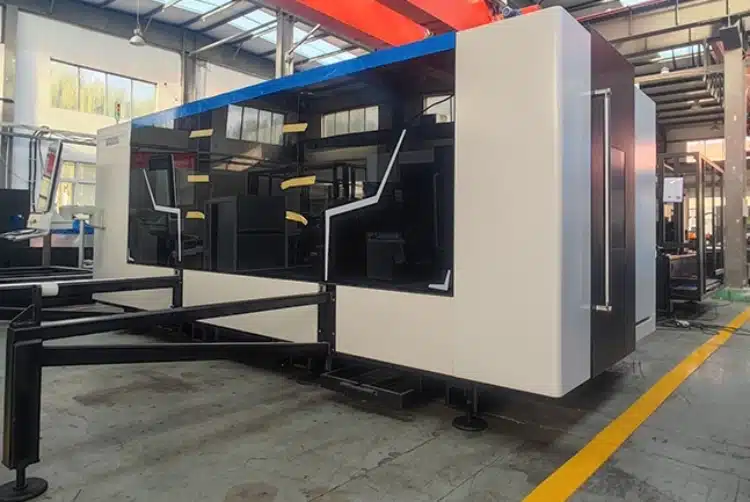
For thick aluminum sheet work, the آلة القطع بالليزر VIB is the most suitable product to introduce.
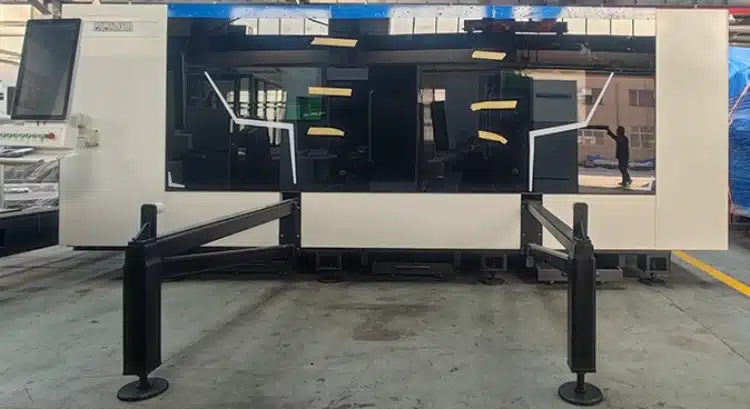
The VIB series is built for heavy-duty sheet metal cutting and offers laser power from 1500 to 20000 W. VIB6025 provides a 6000 × 2500 mm cutting area, with positioning accuracy of 0.05 mm and repositioning accuracy of 0.03 mm. The range also includes an advanced cutting head, heavy welded bed, servo motion, linear guides, and high-pressure gas options.
You can compare it with other Victory Industry laser cutting machine options if your normal plate size or production mix is different. Buyers who want to check the company’s equipment background and quality approach can also review صناعة النصر and its company information.
استنتاج
The best fiber laser cutting machine for thick aluminum plates in 2026 is the machine that can repeatedly handle your normal alloy and thickness at an acceptable speed and edge quality.
Check laser power, piercing, gas delivery, focus control, nozzle condition, motion accuracy, bed rigidity, cooling, and handling as one system. Most importantly, separate a one-time maximum cut from a thickness you can run every day.
If you are comparing configurations, send your alloy grade, plate thickness, drawings, hole sizes, and expected output through the Victory Industry contact page and ask for a sample cutting test before choosing the final machine.
FAQs
What Is Considered Thick Aluminum for Fiber Laser Cutting?
Around 10 mm and above is a useful starting point for discussing thick aluminum in normal sheet-metal work, but the practical definition depends on laser power, alloy, speed, and required edge quality.
How Much Laser Power Do You Need for 20 mm Aluminum?
Both 12 kW and 20 kW process settings can be used as reference points. A 12 kW setup lists about 0.8–1.2 m/min for 20 mm aluminum alloy, while a 20 kW setup lists about 1.5–2 m/min under the corresponding nitrogen settings.
Is 20 kW Always Better than 12 kW for Aluminum?
No. Higher power can improve speed and give more reserve for thicker work, but the right choice still depends on your normal thickness, pierce count, gas cost, edge standard, and daily workload.
Why Does Thick Aluminum Leave Bottom Dross?
Common causes include unsuitable focus, insufficient or unstable gas flow, nozzle problems, incorrect speed, plate condition, and a poor piercing sequence. Increasing laser power alone may not fix it.
Do You Need Nitrogen for Every Aluminum Job?
No. Nitrogen is useful when a low-oxidation edge is important. Dry compressed air may suit some jobs when the required edge finish allows it. The final choice should be checked with your actual part.
What Should You Ask for During a Machine Test?
Ask for cutting speed, pierce time, gas pressure and consumption, hole quality, kerf, taper, bottom dross, repeatability, and the amount of post-cut finishing. Bring your own alloy and drawing whenever possible.