











Introduction
Workshop Welding Challenges
Modern workshops are not interested in buying a handheld laser welding machine just because it looks good. Handheld laser welding machines are often considered when traditional welding methods are delaying production. This could be down to the fact that the welds require a lot of grinding, that thin sections are prone to distortion, or that the welds are visible and require a lot of polishing to give a satisfactory appearance.
Victory Industry and VIW-P Laser Welding Machine
Handheld laser welding is a great option for shops like sheet metal fabrication, stainless steel fabrication, cabinet making, metal furniture manufacturers and even repair shops. Once you have control of the fit-up, shielding gas, parameters and proper training of the operator, it can be a huge upgrade for your shop. Victory Industry provides industrial laser systems, CNC forming equipment and automation solutions to buyers all over the world. In this guide we will be referring to the VIW-P Laser Welding Machine and compare it with other portable laser welding machines that are used for production on a daily basis.
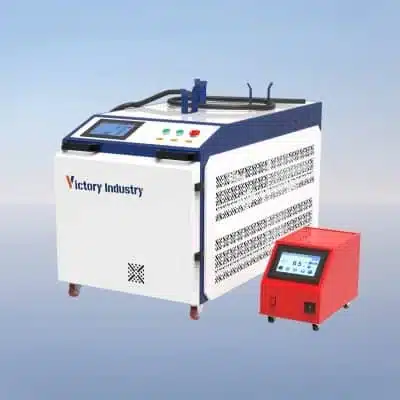
What Is a Handheld Laser Welding Machine?
How the Welding Process Works
Handheld laser welding is a process that uses a focused laser beam to melt and weld metal parts together. The process typically produces a very narrow weld with a small heat-affected zone. This makes it superior to many manual TIG or MIG welds.
What Affects the Welding Result
Note that not every part will be suitable for laser welding. The joint gap, the surfaces to be welded, the material to be welded, its thickness, the welding speed, the shielding gas used and the fixture can all influence the result. When the job matches the process however, it is possible to weld faster while reducing post-processing as much as possible and achieving a good surface finish.
Why Do Workshops Choose Handheld Laser Welding?
Reduced Post-Processing Cost
The main reason is not only welding speed. In many factories, the real cost comes after welding. One worker welds the batch, another grinds the weld, and another polishes the surface. If the plate bends, the part may need repair or replacement.
Cleaner Welds and Lower Deformation
Using handheld laser welding has several advantages in relation to your production. Firstly the weld bead is very clean, so as long as the parameters have been set correctly then the weld will look good. Secondly the heat-affected zone is smaller than with many other processes, which results in less deformation on thin and medium-thickness parts. Finally there is less spatter and consequently less time spent on finishing the welds, which results in a more efficient production process.
Suitable Finished Metal Products
Many welds can be left visible on finished stainless steel products such as cabinet work, kitchen equipment, store displays, furniture, enclosures, sheet metal work, display racks, brackets, light work and ornamental metalwork.
Key Features of a Good Handheld Laser Welding Machine
More Than Laser Power
Don’t just compare handheld laser welding machines by power. A good machine contains a number of elements which will determine its usefullness on a daily basis. Output stability, user comfort, cooling, safety and flexibility of process are all important to consider.
Stability, Cooling and Operator Comfort
The laser source must be capable of a constant output to assure consistent welds. The handheld welder must be light enough for long hours in the plant and also be able to negotiate around corners, across edges and down narrow weld joints. In most factories, machines are in operation for hours a day, thus an industrial water chiller is an important aspect. Easy to use controls on the weld controller allow operator to change power, speed and process parameters to optimize welds on stainless steel, carbon steel and aluminum alloy parts.
Wire Feeding and Safety Design
Wire feeding is another feature that’s also useful in practical workshops. If the joint gap isn’t perfect, the weld can be reinforced using filler wire. The safety features mentioned previously – such as interlocks, emergency stop, protective shell design, laser safety eyewear guidance and the controlled workspace – should be considered as standard features in any welding system.
Related Laser Equipment Options
For related equipment categories please see our Laser Equipment for sale page for a buyers guide to the company’s products.
Main Advantages in Real Production
Clean Welding Appearance
Advantage 1: Clean welding. By matching the material with the correct welding parameters laser welding ensures that the weld is clean and free from spatter, heat marks and requires minimal if any polishing.
Less Heat Deformation
Lower part deformation is another advantage of a smaller heat-affected zone. The thin sections of stainless steel, carbon steel panels, and aluminum alloy parts can easily be damaged by too much heat.
Flexible Operation for Large or Irregular Parts
Portable laser welding machines offer flexibility at work. Parts too large, too irregularly shaped or just too inconvenient to move to a fixed welding station are no problem for such a machine. It simply comes to the work.
Shorter Learning Curve
The fourth advantage of handheld laser welding is that there is a short learning curve for most of the basic welding tasks. As with any process, the operator will need to learn safety procedures as well as become familiar with the process parameters required to produce a quality weld. However, for many of the typical manual welding processes, the handheld laser welding process is easier to standardize and teach to an operator.
Handheld Laser Welding vs TIG and MIG Welding
When TIG and MIG Still Make Sense
TIG and MIG welding can be very useful in their own right. Thick structures, heavy parts and some joint configurations are best tackled with the more traditional welding methods.
Where Laser Welding Performs Better
Handheld laser welding has advantages in terms of speed, the appearance of the weld, and in terms of deformation. In contrast to TIG welding, which also produces high-quality welds but in a significantly slower manner, frequently requiring great skill on the part of the welder, with handheld laser welding, MIG welding for example is efficient but produces a great deal of spatter that has to be removed and frequently also require a great deal of finishing work, particularly if the welds are visible.
How to Choose the Right Welding Method
A selection can be made based on material, thickness, joint type, required surface finish and production volume. The advantages of the laser welding process have to match the production problem in question. Laser welding is not a replacement for other welding processes.
Recommended Product: VIW-P Laser Welding Machine
Why VIW-P Fits Workshop Welding
VIW-P Laser Welding Machine is designed as a portable hand held laser welder, perfect for use in a workshop or industrial setting. It provides buyers with perfect welds, mobility and reliability, ideal for stainless steel, sheet metal, cabinets, brackets, kitchen equipment, furniture components and many more repair jobs that require precise welds.
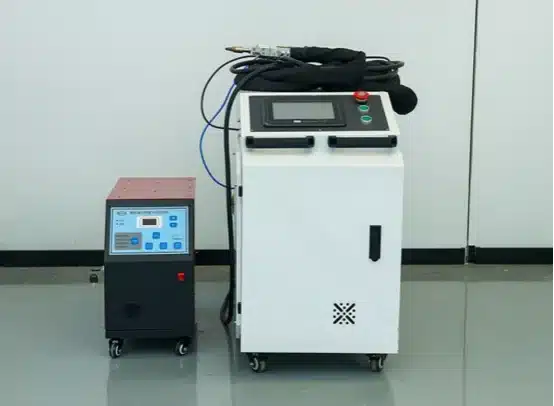
VIW-P Laser Welding Machine Buying Value
Item Buying Value
Power options 1500W / 2000W / 3000W powerful choices for various material thickness and workload.
Cooling method Industrial water cooling for stable longer operation
Welding head Handheld structure for edges, corners, narrow seams and mixed-size workpieces.
Wire feeding Optional support for small joint gaps and additional filler material.
Safety design Interlock, emergency stop and protective structure for safe operation.
Options Nitrogen generator, exhaust system, double wire feeding and positioning system.
How to Select 1500W, 2000W or 3000W
An air compressor for 1500W welding will typically be made of thinner sheet metal and will be lighter enough to move around daily for the welding. 2000W air compressor gives more flexibility in medium work load workshops. For 3000W welding, parts are thicker and need more air power. Compressor needs better cooling and safety features. As always, test a few samples before making a final choice.
Where Does This Machine Fit Best?
Suitable Application Scenarios
Handheld laser welding works best for sheet metal assemblies, cabinets, enclosures, stainless steel products, kitchen equipment, metal furniture, display racks, automotive brackets, precision fabrication and repair work.
When Handheld Laser Welding May Not Be Enough
These conditions may not be suitable for sheet metal welding, such as parts with large joint gaps, poor fit-up, dirty surfaces, very thick sections, etc. and also parts that require deep traditional welding preparation. Then, you may need to use fixtures, edge preparation, wobble welding, special filler wire, etc. and also other welding processes.
When to Consider a Complete Production Line
If a complete production line is needed rather than just one machine, industrial services from Victory Industry can assist with configuration review, process planning, training, and after sales discussion.
What Should You Check Before Buying?
Prepare Material and Part Information
Before asking only for price, prepare your material type, thickness, joint design, sample photos, drawings and target daily output. These details help the supplier recommend the right power level, wire feeding option, cooling setup and safety configuration.
Check Gas, Fixtures, Training and Sample Testing
It is also good to find out what shielding gas, what fixtures, consumables, installation, maintenance and operator training the supplier will offer you. Doing a sample welding test before delivery is also a good idea. The supplier can test your material, check out a parameter window for you, send you some weld photos or videos and lots of other things to reduce uncertainty before the welding equipment is delivered to you.
Further Application and Company Information
More information about applications and equipment can be found on our technical blog as well as our review of Victory Industry for background information on the company.
Conclusion
Final Recommendation
Handheld laser welding improves production greatly where the main problems are: welding too slowly, welds being visible, thin plates warping and too much polishing after welding. The greatest value of laser welding is found in thin to medium size metal fabrication where appearance, speed and consistency are crucial.
How to Get the Right Configuration
VIW-P Laser Welding Machines – Pragmatic Option for 1500W, 2000W or 3000W for practical application with water cooling, wire feeding option, safety and flexibility on your production floor. Based on your real parts – not only on the power – we can recommend the best Machine for your specific needs. Send us the material, thickness, drawings, joint pictures and your output requirements to the contact page for a proposal with the best configuration for you, a test plan for your samples and a quote.
FAQ
Q1: What is typical material thickness for Handheld Laser Welding?
A1: Material thickness for Handheld Laser Welding is determined by laser power, material type, joint design, fit-up and welding speed. Please specify material thickness and then we can decide between 1500W, 2000W and 3000W with some sample photos.
Q2: Can handheld laser welding replace TIG or MIG welding?
A2: It can replace TIG or MIG in many thin and medium metal jobs where clean appearance, low deformation and less grinding are important. For thick sections, heavy structures or special joints, TIG or MIG may still be needed.
Q3: What is the common shielding gas used?
A3: Argon or nitrogen are typical gases used. The process material is a consideration for selecting the proper gas for reducing oxidation and for a good bead shape.
Q4: Is handheld laser welding safe for new operators?
A4: Handheld laser welding can be safe for new operators provided they receive proper training, and the workshop is set up safely. This includes provision of protective eyewear, a laser-safe working area, emergency stop facility, fume extraction and clear work procedures.
Q5: How to select between 1500W, 2000W and 3000W?
A5: Based on the material to be welded, thickness, joint type, work load and required welding speed. Lighter sheet metal work with 1500W, broader medium-duty work with 2000W and higher power demand work with 3000W.