











Industrial robotics is growing because many factory problems cannot be solved by adding labor alone. Welding quality can change during a long shift, while cutting and CNC equipment may sit idle because parts are not moved in time.
The International Federation of Robotics reported 542,076 industrial robot installations in 2024, while the worldwide operating stock reached 4.66 million units. Metal and machinery production accounted for 16% of new installations. Automation is no longer limited to large automotive plants, though not every workshop needs a robot.
Victory Industry supplies laser systems, CNC forming equipment, robotic welding and cutting systems, and automatic loading and unloading equipment for overseas factories. Its project work begins with the actual part. Material, fixture quality, target cycle time, safety rules, and floor space affect the setup.
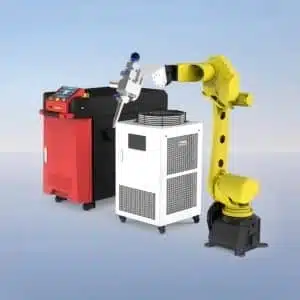
Why Is Industrial Robotics Becoming More Common in Welding Work?
Welding is often where a factory first notices the limits of manual work. Skilled welders remain important for repairs and unstable fit-up. The pressure appears when the same cabinet, bracket, frame, or sheet-metal assembly must be welded hundreds of times.
Repeated Welding Needs More Stable Quality
A robot can repeat the same torch angle, travel speed, path, and sequence. This reduces variation across a batch, but it does not guarantee a perfect weld. Joint gaps, shielding gas, fixtures, parameters, maintenance, and material condition still decide the result.
For repeat parts, robotic welding systems can reduce rework and make inspection easier. Operators can focus on setup, programming, sample checks, and unusual parts.
Smaller Heat Input Can Limit Part Distortion
Laser welding uses a concentrated heat source. Compared with many arc-welding processes, it can produce a narrower heat-affected zone and less distortion when the joint, focus, speed, and fixture are properly controlled. This helps with stainless steel cabinets, enclosures, thin brackets, and parts that are expensive to straighten or polish.
Less distortion can also keep holes and mating surfaces closer to the drawing.
How Robotic Arm Integration Improves Daily Production
A robot arm changes more than welding speed. Parts must enter and leave the cell without slowing the next cycle. Pins, clamps, stops, and positioners need to locate each workpiece consistently. For mixed production, quick-change fixtures and saved programs can cut changeover time.
Long runs test the whole system. A stable base and sized water chiller help, while lenses, nozzles, gas, filters, and robot cables still need routine checks.
How Are Cutting and Machine Tending Changing the Production Flow?
Factories rarely automate one process in isolation for long. A faster cutter sends more parts to bending and welding, while a short-cycle CNC machine may wait for the next blank. This is why robotic cutting systems and machine tending robots often enter the same planning discussion.
Robotic Cutting Works Well on Complex 3D Parts
A flatbed laser cutter is the usual choice for sheet. A 6-axis robotic cutting cell serves a different job: trimming formed parts, cutting complex contours, working around tubes, or reaching several faces of a 3D component. Results depend on fixtures, calibration, path planning, and material location. Vision or a positioner may be needed.
For ordinary sheet-metal blanking, the VIF-A Laser Cutting Machine is a more direct example. It is offered in 1000W to 3000W versions, with listed positioning accuracy of 0.05 mm and repositioning accuracy of 0.03 mm. Buyers should still test their own material, thickness, gas, and edge requirement before treating catalogue figures as shop results.
Machine Tending Reduces Idle Time Around Equipment
Machine tending uses a robot or automatic arm to load raw parts and remove finished ones. End-of-arm tooling may use pneumatic grippers, vacuum cups, or magnetic tools. The correct choice depends on weight, shape, surface, temperature, and scratch limits.
The important figure is the complete cycle: pick, orient, load, confirm, wait, unload, inspect, and place. PLC signals, buffers, conveyors, and safe operator access often decide whether it runs smoothly.
How Do Welding, Cutting, and Tending Work Together?
A line moves only as fast as its slowest reliable step. Buying a fast laser cutter may simply move the queue to welding. Automating welding can then expose a slow unloading or inspection stage.
Faster Cutting Can Move the Bottleneck Downstream
Production managers should record loading, program changes, fixture cleaning, inspection, and small stops. These minutes are easy to miss before installation.
Cycle Time Must Be Balanced Across the Cell
A buffer can keep one machine working while another completes its cycle. One robot may serve several machines when the layout allows it. In other cases, a dedicated robot is simpler. Part flow, floor space, shifts, and maintenance access decide the layout.
What Makes VIW-R a Practical Choice for Automatic Laser Welding?
The VIW-R Laser Welding Machine is built for fixed industrial use and robotic arm integration. It is available in 1500W, 2000W, and 3000W versions, uses water cooling, and includes a control system, safety interlock, and emergency stop. Its published welding gap requirement is no more than 0.5 mm, so controlled fit-up still matters.
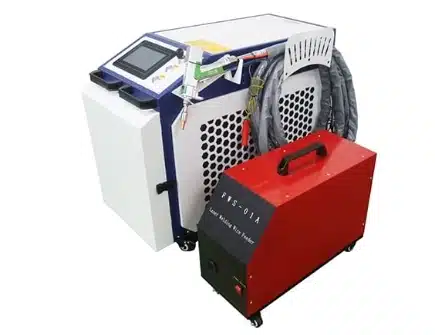
Power Options Need to Match the Actual Joint
Higher power is not automatically better. Material, thickness, joint type, penetration target, gap condition, wire feeding, welding position, and expected speed all matter. A sample test with the buyer’s parts is more useful than a thickness chart alone.
Robotic arm integration helps with repeated paths and difficult angles. The final result also depends on robot reach, payload, fixture layout, cable routing, and the process window.
Safety and Optional Equipment Need a Full Review
An interlock and emergency stop are only part of a robotic laser welding cell. The project may also need an enclosure, guarded doors, fume extraction, access control, risk assessment, and training. Optional wire feeding, nitrogen supply, exhaust equipment, and positioning devices should be confirmed in the quotation instead of assumed to be standard.
What Should You Check Before Investing in Industrial Robotics?
Start with the work that causes the most delay, rework, or safety concern. Automation makes sense when the task repeats and incoming parts are controlled. It is less convincing when designs change often, gaps vary, or fixtures are not ready.
Start with the Part, Fixture, and Production Mix
Send drawings, 3D files when available, material grades, thicknesses, joint types, part weight, daily volume, and quality limits. Explain how often the product changes. A supplier cannot size the robot, gripper, positioner, or laser process from a few photos.
Calculate ROI from Hours, Rework, and Downtime
Use current shop data: operator hours, overtime, scrap, rework, machine waiting time, consumables, and output per shift. Then include programming, fixtures, safety equipment, training, maintenance, and changeover time. The purchase case should be clear on paper.
Check Service Support Before the Machine Ships
Overseas buyers should settle installation, remote support, training, spare parts, maintenance schedules, and acceptance testing before shipment. Victory Industry provides automation integration and service support for layout review, sample testing, setup guidance, and maintenance planning. Clear acceptance criteria make commissioning easier for both sides.
Conclusion
Industrial robotics is growing in welding, cutting, and machine tending because these jobs have repeated motion, measurable cycle times, and clear quality targets. The better projects do not begin with a robot model. They begin with a stable part, a workable fixture, a real cycle study, and a safety plan.
For repeated laser welding, the VIW-R Laser Welding Machine offers three power choices, robotic integration, water cooling, and core control and safety functions. The same rule applies to cutting and handling: test the real part, balance the whole process, and confirm optional equipment before ordering.
Factories preparing a project can contact Victory Industry with drawings, materials, thicknesses, target output, quality requirements, and workshop layout. That gives the supplier enough detail to recommend a workable cell.
FAQ
Q1: Why Is Industrial Robotics Growing in Welding, Cutting, and Machine Tending?
A1: These processes involve repeated movement, measurable cycle times, safety risks, and quality checks. Robots can reduce variation and idle time when parts and fixtures are consistent.
Q2: What Parts Are Suitable for Robotic Welding?
A2: Repeat parts with stable joints, controlled gaps, and reliable fixtures are the best starting point. One-off repairs and parts with poor fit-up may remain better suited to skilled manual welding.
Q3: Does VIW-R Laser Welding Machine Support Robotic Arm Integration?
A3: Yes. It is designed for fixed industrial use and can be integrated with a robotic arm for repeated or complex welding paths.