











A sheet metal fabrication line is not only about buying a laser cutter and putting a bending machine beside it. In a real workshop, every step pulls the next step along. Cutting speed, laser power, sheet thickness, material type, bending force, tooling, backgauge accuracy, operator habits, and part handling all affect the final output. If cutting is fast but bending is slow, parts still wait on the floor. If bending is accurate but the cut edge is bad, the operator still wastes time adjusting the angle.
For buyers who want a practical line, Victory Industry is worth checking. The company can supply laser cutting, laser welding, laser cleaning, MOPA laser marking, sheet metal folding / CNC press brake machines, robotic welding and cutting, and also loading / unloading systems, automatic. It is a useful range, because most of the sheet metal working companies start with just a few of machines. Then, when they have more work, they add some more machines for marking, welding, cleaning, and also automation.
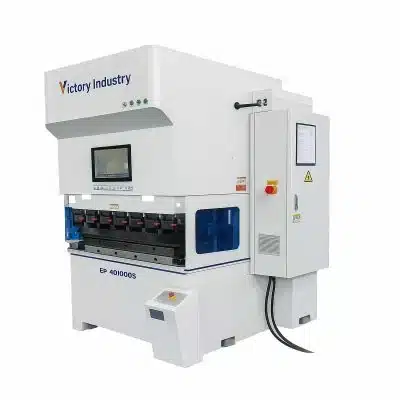
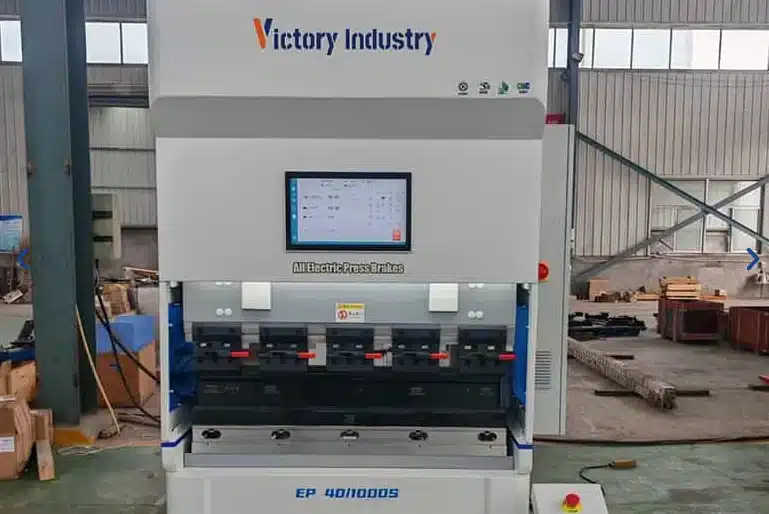
The main product in this line is the Electric Servo CNC Press Brake. It is not just a machine after cutting. It decides whether flat sheets become clean cabinets, panels, frames, doors, brackets, shelves, ducts, and enclosures. If bending is unstable, the whole line feels unstable, even when the laser cutter is powerful.
How Does Fiber Laser Cutter Power Selection Shape the Whole Fabrication Line?
The cutting machine part is a consideration when picking a press brake, as you need to know what is going to be sent to the bending area on a daily basis. Thus the selection of a fiber laser cutter must also be considered, as its power will determine several key criteria: edge quality, cutting speed, part burrs, part dimensional accuracy, and how easy or hard a part will be to bend. All of these factors will affect the operator’s job, making one die or tool set much easier to use than another.
Match Laser Power with Material and Daily Thickness
Laser power should match your normal jobs, not only the thickest plate you may cut once in a while. For stainless steel, carbon steel, and aluminum, the setup is different. A Fiber Laser Cutting Machine used for stainless steel may care more about clean nitrogen cutting and stable surface quality. For aluminum, reflection control, cutting head stability, and cooling also matter.
A simple way to sort it:
| Main Cutting Job | What to Check First |
| Thin stainless steel sheets | Edge color, nitrogen use, fine contour quality |
| Carbon steel plates | Oxygen cutting, piercing stability, slag control |
| Aluminum sheets | Reflection control, power reserve, stable cooling |
| Mixed custom parts | Program change speed, nesting, operator setup time |
If you cut thin and medium sheets most of the time, very high power may not give the best return. It may cost more, use more support equipment, and need stronger gas supply. But if thick aluminum or medium-thick carbon steel is common in your shop, a low-power machine can slow every later step. The point is simple. The laser must feed the bending station with clean, accurate parts.
Keep Cutting Accuracy Ready for Bending
After laser cutting, parts must follow the drawing during bending. Holes, slots, notches, and edges need to be stable. If the part size moves even a little from batch to batch, the press brake operator has to adjust more.
Electrical cabinets and stainless steel enclosures need clean edges and repeat dimensions. HVAC ducts need consistent lengths and bend positions. Kitchen equipment, metal doors, shelves, and frames need edges that do not create problems during forming. Laser power, gas purity, nozzle condition, focus position, and cutting speed all show up later at the press brake.
This is why a buyer should ask for sample cutting before ordering. Send common drawings, not only perfect test shapes. A supplier should test real material, common thickness, hole distance, outside contour, and bend-related dimensions. That gives a more honest view of the line.
Fiber Laser vs CNC Punch Press: Why Should Bending Capacity Be Planned Together?
Many factories still compare fiber laser vs CNC punch press before upgrading. That is a useful comparison, but it should not stop at the cutting step. You also need to ask what happens after the flat part is made.
Choose Laser Cutting for Mixed Shapes and Small Batch Orders
A CNC punch press can still be useful for repeated punched parts, especially when the hole pattern is simple and the volume is high. But many workshops now receive smaller batches, changed drawings, different materials, and more custom parts. One week may include stainless steel panels, aluminum brackets, mild steel frames, and electrical box covers.
For this kind of job mix, fiber laser cutting is easier to adjust. You do not need a new punch tool for every shape. A drawing change can be handled through the program. Different contours, holes, slots, and irregular profiles are easier to process.
So fiber laser vs CNC punch press is not only about speed. It is also about tool cost, order flexibility, and whether your shop can accept different jobs without spending too much time preparing tools.
Let the Press Brake Carry the Value After Cutting
Once laser cutting takes over more shapes, bending becomes more important. Flat cut parts still need to become usable products. This is where the Electric Servo CNC Press Brake carries real value.
For high-mix production, the press brake needs fast setup, accurate positioning, stable ram movement, and reliable tool changes. A slow bending process can cancel the benefit of a fast laser cutter. A good cutting line should be paired with a CNC press brake that can handle frequent part changes without too much trial bending.
Why Does an Electric Servo CNC Press Brake Fit Modern Sheet Metal Shops?
A press brake should be chosen by your real part list. Tonnage alone is not enough. You need to check bending length, material thickness, V-opening, bend radius, control axes, tooling, safety, and possible automation later.
Use Multi-Axis Control for Faster Repeat Bending
A CNC press brake bends sheet metal by pressing a punch into a die with controlled force and motion. Modern systems can use Y1/Y2, X, R, Z1/Z2, and crowning to improve repeatability.
For daily work, this means the operator can call up programs faster and repeat bends with less guessing. Multi-axis backgauge control helps position parts. Crowning compensation helps reduce angle differences between the center and both ends of long parts. This is important for cabinets, enclosures, elevator parts, frames, long panels, and HVAC ducts.
Compared with old hydraulic machines, an electric servo system has some clear shop-floor benefits. It uses servo control for ram movement, so response is fast and positioning is more direct. It also avoids hydraulic oil leakage risk, cuts down oil-related maintenance, reduces noise, and keeps the bending area cleaner. For factories making precision sheet metal parts, these small daily savings add up.
Choose Tonnage and Working Length from Actual Drawings
Do not choose the press brake only by the biggest number on the quotation. Bending force depends on material tensile strength, thickness, V-opening, bend length, and bend radius. Working length should match your real sheet size and part length.
A rough selection check can look like this:
| Item to Check | Why It Matters |
| Tonnage | Must match material, thickness, V-opening, and bend length |
| Working length | Must cover long panels, doors, frames, and ducts |
| V-opening | Affects required force and final bend radius |
| Tooling type | Standard, gooseneck, radius, and special tools affect part range |
| Backgauge axes | Helps with deeper flanges and complex part positioning |
| Crowning | Keeps long bends more consistent from end to end |
The Electric Servo CNC Press Brake can cover 20-130T and 1000mm-3200mm machining length. That range fits many light and medium sheet metal jobs, especially cabinets, enclosures, stainless parts, small frames, brackets, panels, and high-mix bending work. If your shop handles heavier plates or longer parts, you may also compare other CNC Press Brakes in the same product range.
How to Connect Cutting, Bending, Marking, and Automation
A sheet metal line can start simple. It does not need to become a fully automated factory from the first order. But the layout should leave room for future growth. Many buyers only think about today’s machine price, then regret the layout later when handling becomes messy.
Build a Line from Cutting to Bending First
The basic flow is sheet loading, fiber laser cutting, unloading, sorting, CNC bending, welding or assembly, then marking or packing. For many buyers, this is already a big step forward compared with older cutting, punching, and manual bending workflows.
The cutting machine handles shape. The press brake handles form. If these two steps match well, your shop can make stainless steel panels, aluminum parts, cabinets, shelves, brackets, frames, and ducts with fewer delays.
A practical entry line may use one fiber laser cutter, one electric servo press brake, manual sorting, and basic welding or assembly. A balanced line may add pallet changer, better sorting tables, quick clamping, and bend programs. A high-output line may add tower storage, automatic loading and unloading, robotic welding, and part marking.
Add MOPA Laser Marking for Traceability
MOPA laser marking can be added when parts need QR codes, serial numbers, logos, batch numbers, or black marks on stainless steel. This is useful for machinery parts, electrical panels, automotive parts, and hardware.
The VIM-MD Laser Marking Machine can sit after cutting and bending without disturbing the main line. For buyers who need traceability, product ID, batch control, or customer logos, marking should be planned early. It is much easier to leave room for a marking station during layout planning than to squeeze it into the line later.
Use Automation When Handling Becomes Slow
When cutting speed goes up, manual handling often becomes the bottleneck. Loading and unloading robots, pallet changers, buffer stations, vacuum grippers, magnetic grippers, and sorting tables can reduce waiting time.
But automation should solve a real problem. If daily output is still low, manual handling may be enough. If operators spend too much time moving sheets, sorting parts, or waiting for the next batch, then automation starts to make sense. A supplier should review your material type, sheet size, part weight, cycle time, and operator number before giving an automation plan.
What Should You Check Before Ordering the Line?
A good line should be easy to run after installation, not only look good during the first test. The checking work before ordering is not exciting, but it saves trouble later.
Check Samples, Parameters, and Bend Data
Before mass production, run sample parts. Check laser power, cutting speed, assist gas, edge quality, bend angle, tooling, and part fit. For bending, keep a bend database for common materials and part types. When similar orders come again, the operator can reuse the data instead of starting from zero.
Send the supplier your material type, thickness range, maximum sheet size, target daily output, part drawings, tolerance needs, and bending requirements. If you only ask “How much is the machine?” the answer will not help much. Good selection starts from real parts.
Check Tooling, Safety, and Operator Training
Tooling affects bending quality directly. Standard punches and dies cover many parts. Gooseneck tools help with return flanges. Radius tools are useful when the required bend radius is larger. Quick clamping reduces tool change time, especially for small-batch work.
Safety also needs to be part of the plan. Light curtains, safety guards, safety foot pedals, dust extraction, interlocks, front support arms, and operator training all matter. A line that stops often because operators are unsure how to run it is not a good line.
This is also where service support matters. Installation, debugging, quality checking, maintenance, training, and later upgrades should be discussed before the order, not after the machine arrives.
Conclusion
A good sheet metal fabrication line should start from real parts. First, match laser power with your material, thickness, edge quality, and daily output. Then choose the Electric Servo CNC Press Brake by tonnage, working length, tooling, axes, crowning, and part change frequency. After that, plan marking, welding, handling, automation, safety, and service based on order volume.
If you are comparing fiber laser vs CNC punch press, the better choice depends on your part mix. For many workshops with mixed orders, stainless steel panels, thick aluminum jobs, cabinets, brackets, frames, ducts, and custom parts, fiber laser cutting plus CNC bending gives more flexibility. The Electric Servo CNC Press Brake is the machine that turns that flexibility into finished parts.
Need help planning a laser cutting and bending line for your sheet metal workshop? Send your material type, thickness range, maximum sheet size, target daily output, part drawings, and bending requirements through the contact page. The team can help compare laser cutting machines, CNC press brakes, tooling, MOPA laser marking, welding, handling, and automation options, then suggest a line configuration that fits your real production work.
FAQ
Q1: How Do I Choose the Right Laser Power for a Sheet Metal Fabrication Line?
A1: Choose laser power by material, thickness, cutting speed, edge quality, and daily output. Stainless steel, carbon steel, and aluminum need different gas and power setups.
Q2: Why Is the Electric Servo CNC Press Brake Important After Fiber Laser Cutting?
A2: It turns flat cut parts into accurate formed parts. Multi-axis control, crowning, quick tooling, and CNC programs help keep bending stable after cutting.
Q3: What Size Press Brake Do I Need After Laser Cutting?
A3: Check your longest part, thickest common material, bend length, V-opening, and required bend radius. The choice should come from your drawings, not only from a general tonnage number.
Q4: Is Fiber Laser vs CNC Punch Press Still Worth Comparing?
A4: Yes. A CNC punch press can suit repeated punched parts, but fiber laser cutting is more flexible for mixed shapes, small batches, stainless steel, and aluminum parts.
Q5: What Is the Main Difference Between Servo Press Brake vs Hydraulic Press Brake?
A5: A servo press brake uses electric servo drive for fast response, clean operation, lower noise, and less hydraulic oil maintenance. Hydraulic machines may still fit some heavier bending jobs.
Q6: Can MOPA Laser Marking Fit Into the Same Fabrication Line?
A6: Yes. MOPA laser marking can add QR codes, serial numbers, logos, batch codes, and traceability marks after cutting and bending.