
Fiber laser cutting ranks among the most common methods in current metal production.According to Mordor Intelligence’s January 2026 update, the global laser cutting machines market reached USD 7.14 billion in 2025, with fiber lasers accounting for approximately 51.7% of total revenue share — the largest segment — and is projected to grow at a CAGR of 9.75% from 2026 to 2031.
When compared to conventional handling techniques, fiber lasers offer high cutting speeds and reliable precision, and fairly modest upkeep needs. In numerous sheet metal facilities, fiber laser machines are widely used to manufacture enclosures, framework elements, supports, and machinery parts.
Fiber lasers deliver energy through optical fibers instead of mirrors. This approach results in strong electro-optical productivity and consistent beam quality. The arrangement further lowers upkeep demands. It achieves this because the light route remains enclosed and avoids reflector calibration. These devices handle substances like carbon steel, stainless steel, aluminum, brass, and copper effectively. Consequently, they fit a broad array of production sectors.
However, the apparatus by itself cannot guarantee cutting performance. A robust laser device might produce poor edge quality if the settings lack proper adjustment. Operators frequently detect that two devices with comparable power capacities produce varying results. This occurs simply due to differences in the cutting parameters.
Production firms commonly highlight that the key elements impacting laser division standards involve laser power steadiness, concentration location, assist gas cleanliness, and tip status. These settings directly shape division productivity and border excellence.
Companies like Victory Industry not only provide fiber laser cutting machines but also deliver process-oriented solutions based on real production requirements.
According to its engineering workflow, Victory Industry supports customers through material analysis, sample testing, and parameter window validation before final machine configuration. This ensures that laser power, cutting speed, assist gas, and focus position are optimized for actual production conditions rather than theoretical settings.
In addition, each system is verified through factory acceptance testing (FAT), including cutting stability, edge quality, and repeatability checks. This process significantly reduces on-site commissioning time and ensures consistent cutting performance after installation.
With capabilities covering laser cutting systems, CNC forming equipment, and automation integration, Victory Industry enables manufacturers to build stable and scalable metal processing workflows.
This assistance enables producers to modify these settings based on actual output situations. Victory Industry specializes in laser frameworks, CNC shaping devices, and mechanization solutions for international production clients.
The upcoming parts describe five settings that affect fiber laser division capabilities. They also outline how proper modifications can enhance output rates and division standards.
What Is Laser Power in Fiber Laser Cutting?
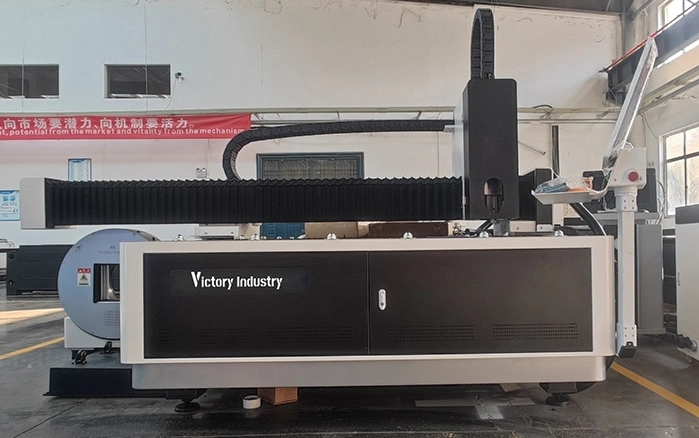
Laser power indicates the power release from the laser origin. It forms the base of the division procedure. The laser needs to supply sufficient power to melt or vaporize the material along the cutting path.In practical applications, power selection is not only determined by thickness but also by production targets such as cycle time and energy efficiency. Victory Industry typically defines a recommended power-thickness matching range during the sample testing phase, ensuring that customers avoid both underpowered cutting and unnecessary energy consumption.
In manufacturing fiber laser devices, laser power generally spans from around 1 kW to over 20 kW. In 2025, high-power fiber laser systems (>12 kW) already represented the fastest-growing segment, driven by demand for thicker material processing (up to 50 mm carbon steel and 30 mm stainless steel in industrial applications).
This range depends on the device setup and use needs. Stronger power frameworks typically serve for denser metal sheets or quicker output velocities.
How Does Laser Power Affect Cutting Performance?
Laser power establishes the greatest depth that division can handle proficiently. As power rises, the ray dissolves substance more rapidly. This permits swifter division velocities.Recent industry benchmarks show that increasing laser power from 6 kW to 12–20 kW can improve cutting speed by 2–4× on mild steel thicknesses between 10–25 mm, while reducing specific energy consumption per meter of cut.
When the power level proves insufficient for the substance depth, the laser ray fails to fully penetrate the material. Consequently, the division might halt midway. It could also leave excessive dross on the bottom edge.
If the power exceeds what is necessary, the division zone might overheat excessively. Such overheating generates uneven borders. It also leads to avoidable power usage.
For instance, devices like the VIF-T Laser Cutting Machine feature designs that accommodate various power setups. This allows producers to align the laser capacity with their usual substance depth and output quantity.Looking for a high-performance fiber laser cutting machine? Contact our experts for a customized solution.
Why Is Cutting Speed Important in Laser Cutting?
Cutting speed determines the processing rate at which the laser tip travels along the division route. It impacts output rates and border standards directly.
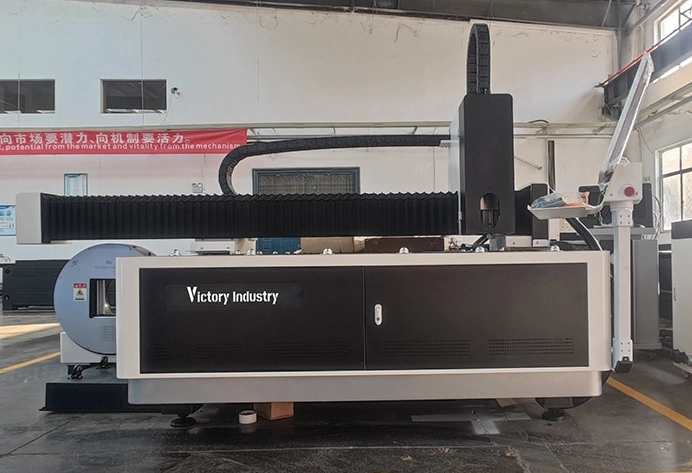
Even after choosing the right laser power, division velocity requires careful adjustment. Excessive or insufficient movement diminishes the division quality.During commissioning, Victory Industry engineers usually establish a cutting parameter database based on different materials and thicknesses. This database allows operators to quickly switch between jobs while maintaining stable quality, which is especially important for high-mix production environments.
What Happens When Cutting Speed Is Too Fast or Too Slow?
Industry data from 2025 indicates typical optimized cutting speeds for mid-power fiber lasers (6–12 kW) reach 18–25 m/min on 6–8 mm aluminum and 8–15 m/min on 10–20 mm mild steel when using nitrogen assist gas.
When velocity exceeds the suitable level, the laser ray lingers on the substance too briefly to dissolve it entirely. This leads to incomplete cutting or uneven borders.
If velocity falls below the optimal rate, the metal absorbs too much warmth. The dissolved metal gathers and creates residue. Additionally, the kerf width increases beyond the anticipated measure.
Skilled operators regularly examine the spark orientation to assess if the division velocity suits the task. Sparks that travel steadily downward in a uniform manner indicate a balanced division procedure.
During device initialization, producers conduct trial divisions to define setting ranges for various substances. These setting collections enable operators to refine the procedure more swiftly in routine output.
What Role Does Focus Position Play in Cutting Quality?
Focus position refers to the point where the laser the laser beam reaches its smallest diameter and peak power density in relation to the workpiece exterior.
Since the ray concentrates more intensely near the focal spot, its placement significantly shapes the division procedure.
How Should Focus Position Be Set?
In real-world uses, three concentration arrangements appear frequently.
Negative concentration situates the focal spot marginally beneath the substance exterior. Producers often apply this for slender sheets. It yields slim division widths and even borders.
Zero concentration positions the focal spot precisely on the substance exterior. This serves as a standard choice for routine division duties.
Positive concentration locates the focal spot somewhat above the exterior. It disperses the ray and aids in dividing denser sheets. The dispersion stabilizes the dissolution area.
Current fiber laser division tips frequently incorporate automatic concentration features. These adjust the focal placement based on substance depth and the division sequence.
How Does Assist Gas Influence the Cutting Process?
According to 2025 market analysis, nitrogen-assisted cutting remains the preferred choice for stainless steel and aluminum (accounting for ~65% of high-value precision jobs), while oxygen continues to dominate thick carbon steel cutting due to its exothermic reaction that enables 30–50% higher feed rates compared to inert gases.
Absent assist gas, the dissolved substance would linger within the division and solidify rapidly. This would obstruct the division route promptly.In industrial environments, assist gas selection is often linked to downstream processing requirements. For example, nitrogen cutting is preferred when parts require welding or coating without additional surface treatment. Victory Industry provides gas selection recommendations based on the entire production workflow.
Which Assist Gas Should Be Used for Different Materials?
Three varieties of assist gas serve commonly in metal division.
Oxygen finds frequent use in carbon steel division. It interacts with heated metal and generates extra warmth. This interaction boosts division velocity.
Nitrogen applies widely for stainless steel. It averts oxidation and yields vivid, pristine borders.
Compressed air offers an economical option for many standard uses. Although border standards may lack the clarity of nitrogen division, the running expense remains lower.
Standard fiber laser division devices accommodate oxygen, nitrogen, or air. The choice depends on the use and desired border standards.
Gas cleanliness and force also shape division outcomes. Minor impurities in nitrogen gas can alter the stainless steel border appearance.
Why Does the Nozzle Matter in Laser Cutting?
The the nozzle is a small but critical component in the division tip. It channels the assist gas toward the division zone and assists in clearing dissolved metal.
Despite its straightforward appearance, nozzle condition has a significant impact on division steadiness.
What Factors Affect Nozzle Performance?
Narrower tips generate more directed gas streams. Wider ones permit increased gas quantity.
Tip structure varies as well. Single-layer and double-layer tips apply to distinct division conditions.
The separation between the tip and the substance exterior constitutes another key element. Excessive or inadequate spacing disrupts gas force spread.
Tips qualify as replaceable parts. They experience wear or pollution after extended division sessions. Regular nozzle inspection and replacement every 200–500 hours of operation (depending on power and material) is standard practice in 2025–2026 industrial settings to maintain consistent kerf width and minimize dross formation.
Within fiber laser frameworks, the division tip generally encompasses replaceable elements like shielding optics, ceramic bands, and tips. These necessitate regular review and care.
Typical Parameter Optimization Reference Table for Fiber Laser Cutting (2025–2026 Industry Data)
| Parameter | Recommended Range / Option | Typical Application Scenario | Impact on Quality & Speed |
| Laser Power | 3–6 kW (thin), 6–12 kW (medium), 12–20 kW+ (thick) | Carbon steel 1–25 mm, stainless steel up to 30 mm | Higher power increases speed but may cause overheating if excessive |
| Cutting Speed | 8–25 m/min (depending on material & thickness) | 6–8 mm aluminum: 18–25 m/min; 10–20 mm steel: 8–15 m/min | Too fast → incomplete cut; too slow → dross & wider kerf |
| Focus Position | -1 mm to +2 mm relative to surface | Thin sheets (negative), thick plates (positive) | Affects kerf width, edge smoothness, and penetration stability |
| Assist Gas Type | O₂ / N₂ / Air | O₂ for carbon steel; N₂ for stainless & aluminum | Determines oxidation level, edge brightness, and cutting speed |
| Gas Pressure | 0.6–2.5 MPa (N₂), 0.3–1.0 MPa (O₂) | High-pressure N₂ for clean cuts | Insufficient pressure leads to slag; too high wastes gas |
| Nozzle Diameter | 1.0–2.0 mm (single/double layer) | Thin sheets: small nozzle; thick plates: larger nozzle | Influences gas flow stability and kerf cleanliness |
| Nozzle Maintenance | Replace every 200–500 hours | Depends on power level and material | Worn nozzle causes unstable gas flow and poor edge quality |
FAQ
Q1: What Parameter Has the Biggest Impact on Fiber Laser Cutting Quality?
A: Multiple settings interact to shape the outcome. Laser power, division velocity, concentration location, assist gas, and tip status all contribute to the final division result.
Q2: How Do You Select the Correct Laser Power?
A: Laser power ought to correspond with the substance category and depth. Denser sheets demand greater power to ensure steady division.
Q3: Why Does Slag Appear on the Bottom Edge of a Cut?
A: Residue typically emerges when division velocity proves too gradual, gas stream lacks steadiness, or tip status deteriorates.
Q4: Which Gas Produces the Cleanest Cutting Edge?
A: Nitrogen generally yields the pristine borders during stainless steel division. It achieves this by preventing oxidation.
Q5: Why Is Nozzle Maintenance Important?
A: A flawed or polluted tip interrupts gas stream. This disruption leads to unsteady division and subpar border standards. Consistent review supports reliable operation.